


Discover

Discover India. East to West. North to South. City by City.

Every place has a story. Stories that sustained us then, sustain us now, and will carry us forward.

Discover the products, places and traditions that give India’s cities and regions their distinct identity.

Know the place. Discover what it makes.

  • From every corner of India
  • From the people who keep it alive
  • From traditions that evolve
  • From stories worth sharing
North India

Chikankari Embroidery

Lucknow, Uttar Pradesh

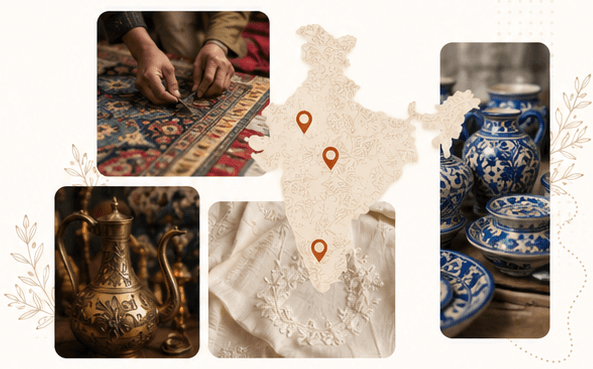
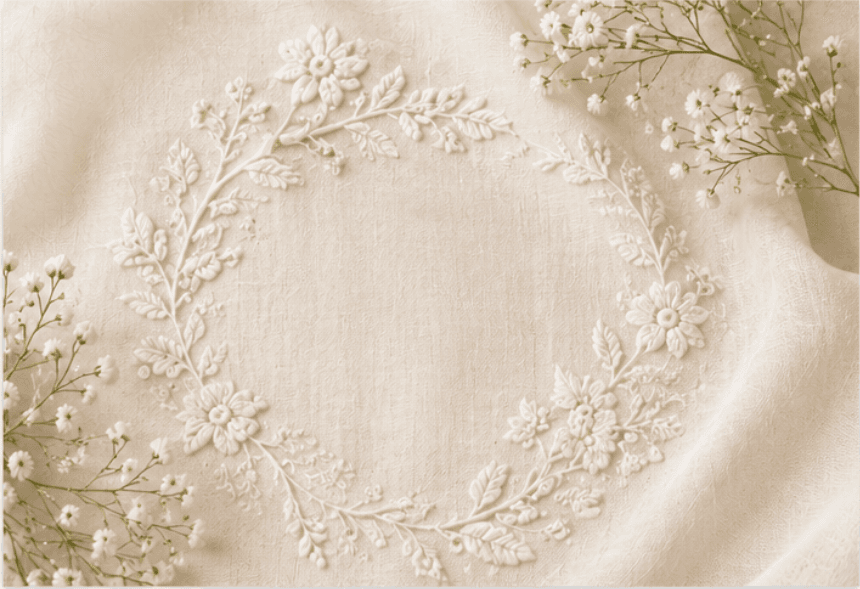
Chikankari is the whitework embroidery of Lucknow: a floral trellis of creepers, buds and paisleys printed in washable ink on fine cotton or sheer fabric, then embroidered — traditionally in untinted white thread — so the pattern reads as texture and shadow rather than colour. Its vocabulary of roughly thirty named stitches falls into three families: flat stitches such as tepchi and bakhiya that lie on or just under the cloth, embossed stitches such as murri and phanda that sit up as tiny grains and knots, and openwork such as jali, where threads of the ground are teased apart with the needle to leave a fine net without cutting the cloth. Worked on pale mulmul, chikan kurtas, saris, dupattas and angarkhas stay cool and near-weightless, and the same piece often passes through several specialists — one for outlining, another for knots, another for jali.

Zardozi Metal Thread Embroidery

Lucknow, Uttar Pradesh

Zardozi is India's principal metal-thread embroidery — raised, dense work in which gold- and silver-coloured wire, coiled purl (dabka, salma), spangles (sitara), beads and stones are couched and stitched onto fabric stretched drum-tight on a wooden frame. It is worked into bridal lehengas and sarees, sherwanis and achkans, saree and dupatta borders, potli bags, shoe uppers, caps, ceremonial umbrellas, and wall panels, canopies and furnishings. It ranges from flat couched line to heavily padded karchobi relief, and Lucknow's zardozi, often combined with chikankari, is GI-tagged.

Jaipur Blue Pottery

Jaipur, Rajasthan

Jaipur blue pottery is a low-fired glazed ceramic whose body is made not from clay but from a dough of ground quartz, powdered glass, borax, gum and water. Pieces — plates, bowls, vases, jars, tiles, coasters, door knobs, soap dishes and animal figures — are painted with cobalt blue and copper turquoise on a white ground, sometimes with brown, green or yellow, and covered in a soft, glassy glaze. Because the body has no clay, it cannot be thrown on a wheel and is instead pressed into moulds or hand-shaped.

Kani Shawl Weaving

Srinagar, Jammu and Kashmir

The loom-woven Kashmir shawl, in which the pattern is built not by a shuttle but by dozens of small wooden bobbins ('kani'), each carrying one colour, worked by hand across a few threads at a time. A single line of the design may pass through hundreds of bobbin movements; a full shawl can take one to three years and is read from a coded pattern script.

Thatheras of Jandiala Guru

Jandiala Guru, Punjab

The hand-hammered brass, copper and kansa (bronze) utensil craft of the Thathera community of Jandiala Guru near Amritsar. Sheets and cast discs of metal are beaten over anvils by teams of craftsmen into degchis, gagars, thalis, bowls and the prized bell-metal dining ware, then scoured bright and often tinned inside.

Kundan-Meenakari Jewellery

Jaipur, Rajasthan

The traditional gold jewellery of Rajasthan, made by two complementary crafts on one piece: 'kundan' setting, in which gems are held not by claws but by slivers of pure refined gold pressed around them, and 'meenakari', vitreous enamel fired onto the gold, usually on the reverse so the piece is beautiful whether the stones or the enamel face outward.

Agra Marble Inlay (Pietra Dura)

Agra, Uttar Pradesh

Agra marble inlay, known locally as parchin kari and in Europe as pietra dura, sets thin slivers of coloured semi-precious stone flush into a white marble ground to form flowers, curling vines, birds, arabesque borders and geometric medallions. It is worked into tabletops, trays, coasters, boxes, plates, lamp bases, chessboards, wall panels and architectural cladding. In the best work the joints between the stones and the marble are so fine that they cannot be felt with a fingertip, and the polished surface reads as a single continuous plane of colour and light. The craft's fame rests entirely on the monuments of Mughal Agra, above all the Taj Mahal, whose inlaid floral dados the modern workshops still copy motif for motif.

Aipan Art

Almora, Uttarakhand

The ritual floor and wall drawing of the Kumaon hills of Uttarakhand, made freehand in white rice paste on a red-ochre ground. Aipan marks thresholds, courtyards, shrines and ceremonial seats with grids of dots joined into lotuses, conches, footprints and geometric 'yantra' patterns, drawn by the women of the house for every festival and rite of passage.

Ajmer Embroidery & Leatherwork

Ajmer, Rajasthan

Around Ajmer and the neighbouring towns of central Rajasthan, cobbling and embroidery families make mojari and juti — flat, pointed, backless slip-on shoes — along with embroidered purses, belts, wallets, camel and horse trappings, and bound boxes. The uppers are decorated with silk-thread embroidery, tiny mirrors, gota ribbon, tilla wire and cowrie or bead trims, often in bright contrast to the natural tan of the vegetable-cured hide. Pilgrimage to Ajmer's great Sufi shrine gave the cobblers a steady, centuries-old market in travellers, and the shoe remains a fixture of Rajasthani wedding dress.

Alwar Pottery & Paper Craft

Alwar, Rajasthan

Alwar in eastern Rajasthan is known for kagzi pottery — literally 'paper' pottery — a delicate grey-to-black unglazed earthenware whose walls are thrown and then scraped so thin that a finished vessel rings when tapped and glows where the light passes through the rim. Bowls, cups, surahis, incense holders and decorative pots are made this way. The town also had a long tradition of handmade paper produced by the Kagzi community, whose craft name the pottery took over as the paper trade declined.

Bagru Block Printing

Bagru, Rajasthan

Bagru, a village near Jaipur in Rajasthan, is known for two related printing styles. Syahi-begar work uses an iron black (syahi) and a yellow-tan alum-and-mud tone (begar) over small repeating floral and geometric motifs. Dabu work is a mud-resist technique in which a paste of clay, lime and gum is block-printed onto the cloth to keep dye out, most often before an indigo bath. Grounds are typically cream, dull red or indigo, and the palette is deliberately earthy. The cloth is made into sarees, dupattas, suit lengths, quilts and yardage.

Banarasi Silk Weaving

Varanasi, Uttar Pradesh

Banarasi silk is the brocade weaving of Varanasi: mulberry-silk sarees, dupattas and lehengas patterned with dense gold and silver zari in Mughal-inspired motifs — buti sprigs, bel creepers, the kalga-and-bel paisley-and-vine, jhallar borders, shikargah hunting scenes and all-over jaal lattices. Among the most prized Indian bridal textiles, it ranges from light georgette and organza sarees to the heavy kinkhab brocade once used for court costume and furnishing. It carries a Geographical Indication covering Varanasi and several neighbouring districts.

Bareilly Zari-Zardozi Embroidery

Bareilly, Uttar Pradesh

Bareilly in western Uttar Pradesh is a major centre of zari and zardozi — raised metal-thread embroidery in which gold- and silver-coloured wire, coils, spangles, beads and stones are stitched onto fabric stretched on a wooden frame. Local karkhanas produce lehengas, sherwanis, saree borders, dupattas, wedding accessories, potli bags, shoe and slipper uppers, and furnishing panels and trims. Bareilly is often called India's 'zari city' because so much of the metal-thread trim used across north India is made there.

Barmer Desert Embroidery

Barmer, Rajasthan

Barmer, in the Thar desert of western Rajasthan, is known for dense folk embroidery worked by women of communities such as the Rabari, Meghwal and Sindhi Muslim herder groups. Small mirrors are anchored with a web of stitches and surrounded by geometric and stylised floral motifs in bright cotton and silk floss, most often on a red, black or indigo ground. It is used on cholis and skirt borders, torans and door hangings, bags, quilts, and camel and animal trappings. Barmer is also a centre for hand block printing in an ajrakh-related idiom.

Basohli Painting

Basohli, Jammu and Kashmir

Basohli painting is the earliest and most distinctive of the Pahari (hill) miniature styles, made from the late seventeenth century in the small Dogra kingdom of Basohli, now in Jammu's Kathua district. It is marked by intense flat colour — saffron, hot pink, emerald green, deep blue — large lotus-petal eyes, strong architectural framing, stylised trees, and, most famously, tiny fragments of iridescent beetle-wing case set into the painting to represent emeralds and other jewels. Favourite subjects are the Rasamanjari love poem, the Gita Govinda, ragamala sets and court portraits.

Bassi Wooden Sculpture & Toy Craft

Bassi (Rajasthan), Rajasthan

Bassi, a town in Chittorgarh district of Rajasthan, is a woodcarving centre known for brightly painted figures of gods and goddesses, animals, dolls, chess-like game pieces, temple models and ritual objects. Its most distinctive product is the kaavad — a portable wooden box-shrine with many hinged doors that a travelling bard opens panel by panel while narrating genealogies and stories to his patrons. Bassi also makes the painted wooden figures of Isar and Gangaur carried in Rajasthan's spring festival, and toys and figures for weddings and fairs.

Bhadohi Hand-Knotted Carpets

Bhadohi, Uttar Pradesh

Bhadohi, with the neighbouring districts of Mirzapur and Sant Ravidas Nagar in Uttar Pradesh, forms India's largest carpet-weaving cluster, sometimes called the 'Carpet City'. Craftsmen hand-knot woollen pile carpets in Persian, Kashmiri, Turkish and modern designs, along with hand-tufted rugs, hand-loomed flat weaves and jute and cotton dhurries, largely for export to Europe and North America. The belt supports a very large loom workforce spread across hundreds of villages.

Bikaneri Camel-Leather Craft

Bikaner, Rajasthan

Bikaner in the Thar desert is known for objects made from camel hide — slender-necked flasks (kupi), bottles, vases, boxes, trays, mirror frames and lampshades — that are moulded to shape, lacquered, and painted in the Usta style with fine gold and colour ornament of flowers, hunting scenes, portraits and Mughal-derived arabesque. The thin hide is naturally translucent, so a lamp placed inside a painted flask turns it into a small glowing lantern. The same gilding-and-painting technique also covers palace ceilings and walls in the city.

Bundi Miniature Painting

Bundi, Rajasthan

Bundi painting is the miniature tradition of the Hadoti region of south-eastern Rajasthan, centred on the courts of Bundi and its offshoot Kota. It is known for densely painted gardens and forests in cool blue-green tones, dramatic skies with lightning and rain, lively animals and birds, and its favourite subjects: ragamala musical modes, the Krishna legends, court portraits, women at leisure and, especially from Kota, energetic elephant and tiger hunts set in tangled jungle. Bundi work is unusually attentive to nature, with every leaf and blossom individually drawn.

Chamba Rumal Embroidery

Chamba, Himachal Pradesh

The Chamba rumal is a square embroidered cloth from the former hill state of Chamba in Himachal Pradesh, used to cover gifts and offerings and exchanged at weddings. Worked in untwisted silk floss on fine hand-woven cotton or muslin, it reproduces the compositions of Pahari miniature painting — Krishna and the gopis, the rasa-mandala circle dance, chaupar games, marriage processions, hunts and ragamala scenes — so faithfully that the finest examples are called 'needle-wonders'. Its defining feature is that it is worked so the picture appears complete and identical on both sides of the cloth.

249+Craft TraditionsAcross India
30States & UTsRich in craft heritage
Country WideSkilled ArtisansKeeping traditions alive
Centuriesof HeritagePassed down generations

Every craft has a story. Every story begins with tradition.