


Discover

Discover India. East to West. North to South. City by City.

Every place has a story. Stories that sustained us then, sustain us now, and will carry us forward.

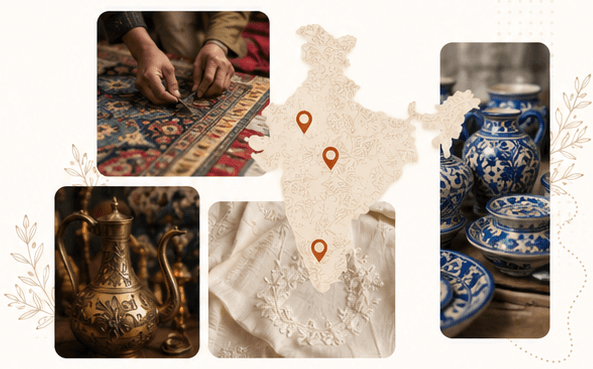
Discover the products, places and traditions that give India’s cities and regions their distinct identity.

Know the place. Discover what it makes.

  • From every corner of India
  • From the people who keep it alive
  • From traditions that evolve
  • From stories worth sharing
Central India

Maheshwari Saree

Maheshwar, Madhya Pradesh

The Maheshwari saree, from the Narmada fort town of Maheshwar in Madhya Pradesh, is a light cotton, silk, or cotton-warp-and-silk-weft cloth with a soft matte sheen, a plain or checked body, small geometric butis, and a distinctive border that is reversible — woven so it can be worn with either side showing. The narrow pallu is typically striped, and the colour palette leans to soft, dusty tones with deeper borders.

Chanderi Fabric

Chanderi, Madhya Pradesh

Chanderi cloth, from the town of the same name in Ashoknagar district of Madhya Pradesh, is a light, semi-transparent fabric woven from fine cotton, pure silk, or a silk-warp and cotton-weft blend, with a characteristic glassy sheen. Chanderi sarees carry gold or coloured zari borders (nakshi) and small woven motifs — the Ashrafi coin, flowers, peacocks, geometric butis — scattered across the body. The translucency comes partly from using unbleached, non-degummed yarn and a very fine reed.

Gond Painting

Patangarh, Madhya Pradesh

A contemporary painting tradition rooted in the Pardhan Gond community of central India, in which animals, trees and deities are built up from dense fields of dots, dashes and fine parallel lines. Each artist works in a signature 'signature pattern' — fish scales, seeds, commas — that fills every form with vibrating texture.

Bagh Hand Block Printing

Bagh, Madhya Pradesh

Bagh print is a natural-dye block-printed cloth from Bagh village in Dhar district of Madhya Pradesh, on the banks of the small Baghini river. It is known for dense, precise patterns — jaali lattices, floral trellises, and motifs named after local architecture, temple carving and plants — printed in a deep alizarin red and a fermented-iron black on a cream, and sometimes indigo, ground. The reds are unusually rich, and Bagh printers credit the mineral content of the Baghini's water for developing them. The cloth is used for sarees, dupattas, stoles, yardage and furnishing.

Bastar Dhokra & Wrought Iron Craft

Bastar, Chhattisgarh

The Bastar region of Chhattisgarh is home to two distinct tribal metal crafts. The Ghadwa community casts brass by the lost-wax method into figures of deities, tribal life, animals, riders, elephants, lamps, jewellery and measuring bowls, all carrying a fine wax-thread texture. The Lohar (blacksmith) community forges thin strips and rods of iron into stylised human and animal figures, wall panels, lamp stands and the jhaar — tall iron 'trees' hung with bells and birds — with a deliberately raw, hammer-marked, forge-welded look. Both are rooted in the ritual and household life of the region's Adivasi communities.

Bherugarh (Bhairavgarh) Printing

Bherugarh, Madhya Pradesh

Bhairavgarh (Bherugarh), on the outskirts of Ujjain in Madhya Pradesh, is a printing centre known for batik — wax-resist dyeing — and for hand block printing. Craftsmen produce sarees, dupattas, yardage and furnishing with the fine crackled lines characteristic of batik alongside conventional block-printed florals and geometrics, often in indigo, black, maroon and earth reds. The cluster grew up around Ujjain's long-established dyeing and printing communities and is now identified specifically with batik.

Bhil Painting

Jhabua, Madhya Pradesh

A contemporary painting style of the Bhil community of western Madhya Pradesh, in which figures of deities, animals, trees and village life are outlined in bright colour and then filled entirely with even fields of multicoloured dots. Each artist's dots are said to represent the ancestors, keeping them present in the picture.

Bhopal Tribal Art & Textiles

Bhopal, Madhya Pradesh

Bhopal, the capital of Madhya Pradesh, is a gathering point for the state's tribal and courtly crafts rather than the origin of a single one. Pardhan Gond and Bhil artists from Dindori, Mandla, Patangarh and Jhabua live in or regularly visit the city, painting in the dotted and dashed styles of their communities and selling through galleries and the tribal museum. In parallel, the old city's Muslim artisans make the batua — a soft drawstring purse — along with caps and pouches worked in zardozi and zari, a legacy of the Bhopal Begums' court.

Budhni Lacquered Wooden Toy Craft

Budhni, Madhya Pradesh

Budhni, a small town on the Narmada in Sehore district of Madhya Pradesh, makes lacquered wooden toys and objects — rattles, teethers, miniature kitchen sets, spinning tops, fruit, cradles, boxes, candle stands, garden ornaments and bangles — turned on a lathe and coloured by the friction application of coloured lac. The forms are simple and rounded, the colours glossy and bright, and the craft belongs to the same broad family as the better-known Channapatna and Etikoppaka lac-turnery.

Burhanpur Handloom Weaving

Burhanpur, Madhya Pradesh

Burhanpur, on the Tapti in southern Madhya Pradesh, is a historic weaving town whose looms produce cotton and silk sarees, dupattas and dress fabric, often with contrasting silk or zari borders and pallus. It was once celebrated across the Mughal world for its fine bafta cottons, muslins and gold-worked cloth, used for robes of honour and export, and although the trade contracted long ago, weaving and metal-thread work remain part of the town's economy.

Dhar Tribal Textile Craft

Dhar, Madhya Pradesh

Dhar district in western Madhya Pradesh brings together two textile traditions. One is the natural-dye hand block printing of Bagh village, a GI-protected craft in its own right, using iron and alum mordants, alizarin and indigo, and river washing. The other is the woven, embroidered and beaded textile work of the district's large Bhil and Bhilala tribal population — coarse pit-loom cotton lengths for waist and head cloths, and cholis, bags and festival garments dense with cross-stitch, mirrors, cowries and beads.

Gwalior Hand Block Printing

Gwalior, Madhya Pradesh

Gwalior in northern Madhya Pradesh has a hand block-printing tradition producing sarees, dupattas, suit lengths and furnishing in delicate repeating florals, buti sprigs, jaal creepers and border designs, printed on cotton, on Chanderi-type cotton-silk and on pure silk. Prints tend to be fine and closely spaced, in indigo, black and madder tones or in soft pastel pigment colours, and printers often work directly on hand-woven Chanderi cloth from the nearby town.

Kosa Silk Weaving

Champa, Chhattisgarh

Kosa is the Chhattisgarhi name for tussar (tasar) silk — a wild silk with a natural dull-gold to fawn colour and a dry, textured handle — reeled and woven across the state, with Champa in Janjgir district a leading centre. It is made into sarees, dupattas, suit lengths, stoles and furnishing, often with woven butis, temple borders and tribal-inspired motifs, and sometimes combined with cotton or mulberry silk.

Mandu Stone & Textile Craft

Mandu, Madhya Pradesh

Mandu (Mandavgad), the hilltop fortress-city of the Malwa sultans in Madhya Pradesh, is best known for its ruined palaces, mosques and pavilions, and its craft identity is closely tied to the region around it. The plateau's sandstone and basalt support a building and carving tradition kept alive by restoration and local construction, and the surrounding Nimar–Malwa towns of Bagh and Maheshwar supply the block-printed and woven textiles that are sold at Mandu and identified with the area.

Ratlam Hand Block Craft

Ratlam, Madhya Pradesh

Ratlam, a trading and railway town on the Malwa plateau of Madhya Pradesh, has a hand block-printing tradition producing cotton sarees, dupattas, yardage and furnishing in the Malwa vocabulary of small florals, buti sprigs, jaal creepers and geometric borders, in indigo, black and madder tones and modern pigment colours. The town is also known for its lac (lakh) bangles — brightly coloured, stone-set bangles formed from softened lac — and, more famously still, for its namkeen (savoury snacks) and sweets.

Tikamgarh Brass & Bell-Metal Craft

Tikamgarh, Madhya Pradesh

Tikamgarh, a former princely town in the Bundelkhand region of Madhya Pradesh, has a long-established brass and bell-metal industry. The Kasera and Thathera smiths make household and ritual utensils — thalis, lotas, bowls, degs, spoons — temple lamps and bells, images of deities, incense burners, animal and bird figures, door fittings, and the ghungroo (ankle-bell strings) used by classical and folk dancers, for which Tikamgarh is a noted source.

Ujjain Textile & Devotional Craft

Ujjain, Madhya Pradesh

Ujjain, one of Hinduism's seven sacred cities and a host of the Simhastha Kumbh Mela, is a temple town on the Kshipra whose craft economy is closely tied to worship and pilgrimage. On its edge, Bhairavgarh is a printing centre for batik (wax-resist dyeing) and hand block printing, producing sarees, dupattas, yardage and furnishing in crackled batik and Malwa-style prints. The city itself supports makers of prayer beads and malas, brass and copper puja vessels, lamps and bells, clay lamps and idols, and the flowers, threads and ritual kits sold to the pilgrims who come for the Mahakaleshwar temple and the Kumbh.

249+Craft TraditionsAcross India
30States & UTsRich in craft heritage
Country WideSkilled ArtisansKeeping traditions alive
Centuriesof HeritagePassed down generations

Every craft has a story. Every story begins with tradition.