


Discover

Discover India. East to West. North to South. City by City.

Every place has a story. Stories that sustained us then, sustain us now, and will carry us forward.

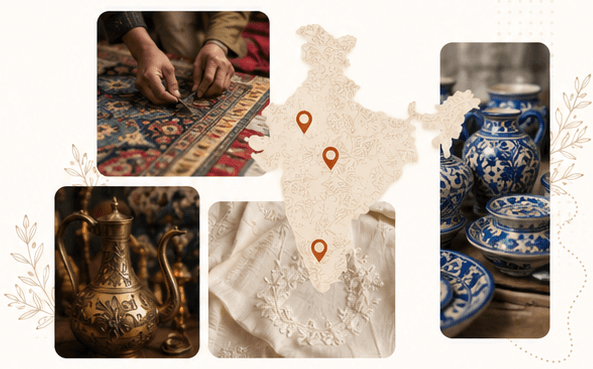
Discover the products, places and traditions that give India’s cities and regions their distinct identity.

Know the place. Discover what it makes.

  • From every corner of India
  • From the people who keep it alive
  • From traditions that evolve
  • From stories worth sharing
East India

Baluchari Silk Weaving

Bishnupur, West Bengal

Baluchari is a silk saree from Bishnupur in Bengal whose deep-toned body is framed by an elaborately figured border and, above all, a pallu filled with pictorial panels — scenes from the Ramayana and Mahabharata, nawabi durbars, women in palanquins, horse riders, hunts and hookah smokers — rendered in one or two contrasting silk colours. A version woven with gold-coloured zari instead of coloured silk is called Swarnachari. The saree reads almost like a comic strip, each rectangular panel a separate scene, with smaller vignettes repeating in the borders.

Bankura Terracotta Horse Craft

Bankura, West Bengal

The village of Panchmura in Bankura district makes the tall, angular terracotta horse — upright pricked ears, an arched neck, a tubular body on four straight legs — that has become an emblem of Indian handicraft and the crest of the All India Handicrafts Board. The potters also make elephants, the Manasa chali (a shrine plaque for the snake goddess), Gauri-Shankar figures, oil lamps, wall panels and decorative animals, all fired to a warm burnt-sienna red.

Bengal Dokra (Lost-Wax) Craft

Dariyapur, West Bengal

Bengal dhokra is lost-wax brass casting practised by the Karmakar (Dhokra Kamar) community, chiefly at Dariyapur in Purba Bardhaman and Bikna near Bankura. The craft produces stylised figures — owls, elephants, horses and riders, peacocks, tortoises, Lakshmi and Durga, tribal dancers, measuring bowls, lamps and jewellery — all covered in a delicate ribbed pattern from the coils of wax thread used to model them. The owl, associated with Lakshmi, is the best-known Bengal dhokra form.

Bengal Jamdani Weaving (Kalna)

Kalna, West Bengal

Jamdani is a labour-intensive figured muslin in which motifs are woven in by hand as a discontinuous supplementary weft, so the pattern appears to float on a sheer cotton ground with no long floats behind it. In West Bengal the craft is concentrated around Dhatrigram, Samudragarh and Kalna in Purba Bardhaman district, and in parts of Nadia, producing sarees, dupattas and yardage in fine cotton, sometimes with silk, zari or a coloured motif thread. Designs range from scattered buti sprigs to dense all-over jaal and heavy figured anchals.

Bengal Patua Scroll Painting

Pingla, West Bengal

A performed painting tradition of Bengal in which the Patua (Chitrakar) artist paints a vertical narrative scroll — a 'jorano pat' — and then unrolls it panel by panel while singing the story it tells in a song they have composed themselves. Subjects run from the goddess Manasa and the life of Krishna to tsunamis, the September 11 attacks and public-health messages.

Berhampuri Silk Weaving

Berhampur, Odisha

Berhampur (Brahmapur) in Ganjam district, Odisha, weaves lustrous mulberry-silk sarees and the traditional joda — a matched dhoti and shawl set — distinguished by the phoda kumbha border, a series of interlocked temple-spire triangles. The silk is used for weddings and ceremony across southern Odisha, and Berhampuri joda is among the cloths traditionally offered to dress the deities at the Jagannath temple in Puri. It carries a Geographical Indication.

Bhagalpuri Silk Weaving

Bhagalpur, Bihar

Bhagalpur in Bihar, long called the Silk City, is the country's main centre for tussar (tasar) silk — a naturally golden, dry-textured wild silk — as well as mulberry, eri and blended silks. Weavers produce sarees, stoles, scarves, dress material, upholstery and furnishing, plain or with woven and printed borders, and the cloth is often finished elsewhere with kantha embroidery or block print. Tussar's slubby, uneven thread gives Bhagalpuri cloth its characteristic dry handle and honey sheen.

Bhubaneswar Stone Carving & Applique

Bhubaneswar, Odisha

Bhubaneswar, Odisha's temple city, anchors two related craft traditions. Stone carvers of the Maharana community cut figures of Hindu deities, dancers, animals, erotic panels and architectural elements in khondalite, laterite and sandstone, continuing the tradition that built the Lingaraja, Rajarani and Konark temples. Nearby Pipili is famous for appliqué — chandua — in which cut shapes of coloured cloth are stitched onto a base to make canopies, umbrellas, wall hangings, lampshades, bags and the ritual gear of the Jagannath temple and its Rath Yatra.

Bomkai Saree Weaving

Sonepur (Odisha), Odisha

The Bomkai or Sonepuri saree originates in Bomkai village of Ganjam district and is now woven mainly in Subarnapur (Sonepur), Odisha. It combines a coarse, comfortable ground with deep contrasting borders, a densely patterned pallu often in a different colour, small supplementary-weft motifs — fish, lotus, peacock, temple, karela — scattered across the body, and frequently a band of tie-dye ikat. The cotton version is everyday and festive wear; a later silk version is used for weddings and ceremony.

Cuttack Silver Filigree (Tarakasi)

Cuttack, Odisha

Cuttack silver filigree, or tarakasi, is an openwork craft in which very fine silver wire is twisted, flattened and shaped into scrolls, flowers, leaves and geometric mesh, then soldered together to make jewellery, boxes, plates, models of monuments, deities, boats and, most spectacularly, the towering silver backdrops (chandi medha) built for Cuttack's Durga and Kali Puja pandals. The work is light, intricate and almost weightless for its size, and the finest pieces have no solid ground at all — the design is held together only by its own wirework.

Darjeeling Himalayan Woollen Craft

Darjeeling, West Bengal

The Darjeeling hills of West Bengal — Darjeeling, Kalimpong and Kurseong — are known for woollen craft carried and developed by their Nepali, Lepcha, Bhutia and Tibetan-refugee communities: hand-knitted sweaters, socks, gloves and caps in colour patterns; woven shawls, jackets, mufflers and bags; and hand-knotted wool carpets in Tibetan designs made at the refugee self-help centres. The crafts sit alongside the region's tea and tourism economy.

Dhaniakhali Saree Weaving

Dhaniakhali, West Bengal

Dhaniakhali, in Hooghly district of West Bengal, weaves a fine cotton tant saree known for an especially tight, close weave that gives it body and durability, a smooth drape and a firm, almost starched handle. The signature is a bold, solidly coloured border — often black, maroon, green or dark blue — set against a lighter body, with a striped or figured pallu and sometimes small butis on the field. It carries a Geographical Indication.

Dhenkanal Dhokra Craft

Dhenkanal, Odisha

Dhenkanal district in Odisha, and especially the village of Sadeibareni, is a lost-wax brass-casting centre where the Sithulia community makes figures of Hindu and tribal deities, elephants, horses, peacocks, tortoises, boats, palanquins, lamps, bells, measuring bowls and jewellery, all carrying the fine ribbed surface produced by winding wax threads onto the model. Sadeibareni is one of Odisha's most active dhokra villages, with most households involved in some stage of the craft.

Kalighat Painting

Kolkata, West Bengal

A bold, quick style of watercolour painting that grew up around the Kalighat temple in 19th-century Calcutta, sold cheaply to pilgrims as souvenirs. Sweeping brushstrokes, rounded shaded figures and a sharp eye for city life turned gods, courtesans, babus and scandals into some of India's first modern popular art.

Kantha Embroidery

Kolkata, West Bengal

Kantha is a running-stitch craft of Bengal in which several layers of soft old cloth — worn saris and dhotis — are laid together and quilted with a simple running stitch, both to hold the layers and to draw pictures and patterns. Traditional nakshi (figured) kantha is covered with folk imagery: the tree of life, lotus, sun and moon, fish, elephants, kalka paisleys, scenes of village and ritual life. Today the stitch is also worked as surface embroidery on new fabric — sarees, stoles, jackets, cushion covers — for the fashion market.

Khandua Ikat Weaving

Nuapatna, Odisha

The tie-dye ('bandha') silk ikat of Nuapatna and Maniabandha in Odisha, in which warp and weft yarns are resist-dyed before weaving so that soft-edged motifs — conch, lotus, elephant, dancing figures, and lines of temple architecture — emerge as the cloth is woven. The sacred version, Khandua pata, is woven for the deities of the Jagannath temple at Puri.

Khatwa Appliqué

Patna, Bihar

The appliqué and cut-work craft of Bihar, in which shapes cut from coloured cloth are stitched onto a contrasting ground to make tents ('shamiana'), canopies, wall hangings and, in its fine form, figurative panels of village and mythological scenes. It is the appliqué counterpart to the state's better-known sujani quilting and Madhubani painting.

Kotpad Natural-Dye Handloom

Kotpad, Odisha

Kotpad handloom, from Koraput district in southern Odisha, is a coarse, durable cotton cloth dyed with the root of the aal (Indian madder) tree, which gives deep maroon, dark brown and, with an iron mordant, black, against an undyed cream ground. It is woven into sarees, dupattas, stoles, dhotis, shawls and blankets, often with simple stripes, temple borders and rows of small motifs — fish, crab, boat, axe, temple — drawn from the life and beliefs of the region's tribal communities, for whom the Mirgan weavers traditionally worked.

Krishnanagar Clay Doll Craft

Krishnanagar, West Bengal

Krishnanagar, in Nadia district of West Bengal, is famous for extraordinarily lifelike clay figures modelled in the Ghurni quarter: fruit and vegetables so realistic they can be mistaken for the real thing, figures of tradespeople and everyday life caught mid-action, deities, mythological groups, animals and portrait busts. The modelling attends to muscle, wrinkle, vein and the fall of cloth, and the painting is done from close observation of skin, produce and fabric.

Madurkathi Mat Weaving

Sabang, West Bengal

The fine floor mats of the Medinipur region of West Bengal, woven from 'madur kathi', the slender reed Cyperus tegetum that grows in the area's clay soil. The best mats — 'masland' — are woven so tight and smooth on a horizontal frame loom with a cotton warp that they roll up like cloth and were once reserved for royalty and used as prayer mats.

249+Craft TraditionsAcross India
30States & UTsRich in craft heritage
Country WideSkilled ArtisansKeeping traditions alive
Centuriesof HeritagePassed down generations

Every craft has a story. Every story begins with tradition.