




Discover

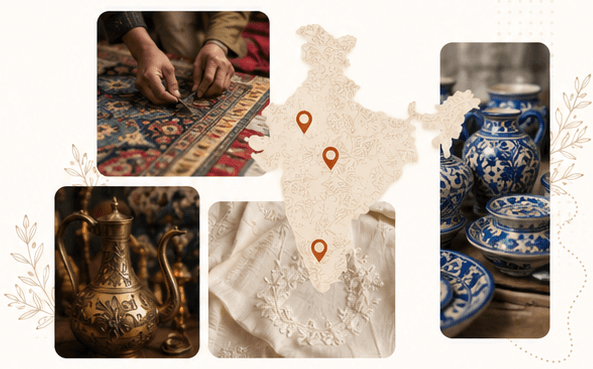
Discover India. East to West. North to South. City by City.

Every place has a story. Stories that sustained us then, sustain us now, and will carry us forward.

Discover the products, places and traditions that give India’s cities and regions their distinct identity.

Know the place. Discover what it makes.

  • From every corner of India
  • From the people who keep it alive
  • From traditions that evolve
  • From stories worth sharing
West India

Warli Painting

Dahanu, Maharashtra

A tribal wall-painting tradition of the Warli Adivasi people of the Sahyadri foothills north of Mumbai, built almost entirely from the circle, the triangle and the line. White rice-paste figures dance, farm, hunt and marry across an earth-brown ground, ringed around the central 'chauk' of the mother goddess Palaghata.

Ahmedabad Textile & Block Printing

Ahmedabad, Gujarat

Ahmedabad and its surrounding villages form one of the oldest cotton-printing and textile-trading centres in the world. Craftsmen print yardage, dupattas, sarees, bed covers, quilts and garments using hand-carved wooden blocks, working in two broad families of technique: mordant styles, in which a printed metallic salt fixes a dye that develops in a later bath, and resist styles, in which a paste, wax or mud is printed to keep dye away from parts of the cloth. Designs range from tiny buti sprigs and geometric jaals to the sprawling flowering trees and paisley butas that European buyers once ordered by the shipload. The city's Calico Museum of Textiles, one of the finest textile collections anywhere, grew directly out of this trade.

Ajrakh Block Printing

Bhuj, Gujarat

Ajrakh is a complex resist- and mordant-printed cloth made in Kutch, Gujarat, chiefly at the villages of Ajrakhpur and Dhamadka. Its deep blue, madder red, black and white patterns are built from geometric grids, eight-pointed stars, trefoils, cintamani dots and floral lattices drawn from Islamic ornament. Traditionally it was the everyday cloth of the Maldhari herding communities, worn as turbans, lungis and shoulder wraps and given at births, weddings and deaths. What sets it apart from most block prints is that it is printed on both faces of the cloth in exact register, so the design reads identically front and back and there is no wrong side. A full Ajrakh passes through sixteen to twenty separate printing, dyeing, washing and drying stages, all using plant and mineral colour.

Bandhani Tie-Dye

Jamnagar, Gujarat

Bandhani, from the Sanskrit 'bandh', to tie, is a tie-dye technique of Gujarat and Rajasthan in which the cloth is pinched up into thousands of minute points and each point is bound tightly with thread before dyeing, so that the tied spots resist the dye and stay their original colour. Opened out, the cloth carries patterns of fine dots that form flowers, figures, elephants, dancers, borders and grids. Classic pieces include the deep-red gharchola and the red-and-white panetar worn by brides, the yellow-grounded pilu of new mothers, and the laheriya and mothda grids. Colour choices, motifs and the fineness of the knotting all traditionally signalled the wearer's community, region and stage of life.

Bhavnagar Wood Carving

Bhavnagar, Gujarat

Bhavnagar and the wider Saurashtra region of Gujarat have a strong tradition of architectural woodcarving — deeply cut doors and doorframes, projecting enclosed balcony windows (jharokha), bracket figures, column capitals, ceiling panels, hanging swings (hindola) and carved furniture such as chests, low seats and cradles. Motifs run to peacocks, parrots, elephants, lions, lotuses, deities, dancers and dense foliate scrollwork, and the wooden facades of the region's old merchant quarters are the craft's showcase.

Bicholim Pottery & Earthenware Craft

Bicholim, Goa

Bicholim and the villages of north Goa are a centre for the Kumbhar (potter) community, who throw everyday red earthenware — cooking pots, curd setters, water jars, kunda basins, lamps, planters — alongside the moulded tiles and bricks used in traditional Goan houses and the clay Ganesh idols made for the Chaturthi festival. The ware is unglazed, fired to a warm brick-red or blackened by a reducing finish, and is still preferred in Goan kitchens for certain dishes.

Goan Pottery, Woodcraft & Shell Craft

Panaji, Goa

Goa's traditional crafts span three materials. Kumbhar potters throw red earthenware — cooking pots, water jars, curd setters, tiles and the clay Ganesh idols made for Chaturthi. Wood carvers work rosewood, teak and matti into furniture, altars, oratories, statues of saints and the decorative fittings of Goan-Portuguese houses and churches. Shell craftsmen cut and polish seashells and coconut shell into lampshades, curtains, jewellery, mirror frames, boxes and mother-of-pearl inlay.

Gondal Beadwork

Gondal, Gujarat

Gondal, in Rajkot district of Gujarat's Saurashtra region, has a domestic craft of beadwork in which small coloured glass beads are threaded and netted on wire and thread into torans, hanging parrots and peacocks, boxes, coasters, toys, fruit, figures of Krishna and Ganesha, and covers, made largely by women for the home and for gifting. The colours are planned so the beads themselves form the pattern — mango shapes, flowers, borders and figures.

Himroo Weaving

Chhatrapati Sambhajinagar, Maharashtra

Himroo is a brocade-like figured cloth of Aurangabad (Chhatrapati Sambhajinagar) in Maharashtra, woven with a cotton warp and a silk or art-silk weft to imitate the far costlier all-silk kimkhab brocade. Shawls, sarees, stoles, dupattas and furnishing are patterned with paisleys, floral jaals, fruit and vine motifs, and designs adapted from the Ajanta cave paintings, in a soft, slightly raised weave against a satin-faced ground. Only a small number of workshops still weave true handloom himroo.

Hupari Silver Jewellery Craft

Hupari, Maharashtra

Hupari, a town in Kolhapur district of Maharashtra, is a major centre for silver jewellery, especially anklets, toe-rings, waist chains, bracelets, hair ornaments and traditional Maharashtrian pieces. Thousands of small workshops and home units make silverware for markets across western and southern India, and the town is nicknamed the 'silver city' for the scale and specialisation of its trade.

Ichalkaranji Textile Weaving

Ichalkaranji, Maharashtra

Ichalkaranji, in Kolhapur district of Maharashtra, is one of India's largest textile-weaving towns, producing cotton and polyester-cotton sarees, dhotis, shirting, bedsheets, towels and dress fabric on a very large base of handlooms, power looms and, increasingly, high-speed shuttleless looms. Its cloth is sold across India and exported, and the town hosts the whole textile chain — spinning, sizing, weaving and processing.

Jetpur Textile Dyeing & Printing

Jetpur, Gujarat

Jetpur, on the Bhadar river in Rajkot district of Gujarat, is a large textile printing and dyeing centre, producing printed cotton sarees, dupattas, dress and furnishing fabric, and a big volume of printed cloth for export, historically to Africa and the Middle East. Both hand screen printing and block printing are used, alongside dyeing and finishing, and the town's riverbanks and fields are famous for the sheets of printed cloth laid out to dry.

Khambhat Agate Stone Craft

Khambhat, Gujarat

Khambhat (Cambay) in Gujarat has been an agate-working centre for thousands of years, cutting banded agate, carnelian, onyx, bloodstone and jasper into beads, pendants, cabochons, bowls, eggs, spheres, animal figures and inlay stones. The raw stone comes as rounded nodules from the basalt of the Rajpipla hills; roasting turns dull grey agate to the prized red-orange carnelian. Cambay beads were traded across the ancient world, reaching Mesopotamia, Egypt and Rome.

Kolhapuri Chappal Craft

Kolhapur, Maharashtra

The Kolhapuri chappal is a flat, open leather sandal made from vegetable-tanned buffalo and cow hide, hand-stitched and often hand-braided, with a distinctive plaited toe-loop or T-strap and a broad, sometimes cross-woven, front strap. It has no nails and no synthetic parts; the leather is thick and hard at first and moulds to the foot with wear. Styles include the sturdy Kapashi, the finer Paytan, and heavily braided and pom-pom-trimmed decorative versions.

Kutch Embroidery

Kutch, Gujarat

Kutch embroidery is not one style but a family of them, each belonging to a particular community of the Kachchh district of Gujarat and each with its own stitches, motifs, colours and rules. Suf is a fine counted surface-satin work built on triangles; Kharek is a geometric grid filled with satin stitch; Rabari work is bold chain stitch with big mirrors and free motifs; Mutwa embroidery is minute and jewel-like; Ahir work uses flowing chain-stitch peacocks and flowers. Mirrors of many shapes are anchored throughout. The work covers cholis, skirts, wedding shawls, torans, bags, quilts and animal trappings.

Mandvi Textile & Maritime Woodcraft

Mandvi, Gujarat

Mandvi, a walled port town on the Kutch coast of Gujarat, has two craft identities. It sits within the Kutch textile belt, so Ajrakh resist-and-mordant block printing and bandhani tie-dye are made in and around it, and sold in its bazaar. And Mandvi is one of the last places in the world where large wooden cargo dhows — the vahan — are still built entirely by hand on the beach, without formal plans, by hereditary shipwrights, for owners in India and the Gulf.

Mashru Weaving

Patan, Gujarat

A satin-weave fabric of Gujarat and the Deccan with a silk face and a cotton back, developed so that the shiny cloth touching the skin would be cotton rather than silk. Traditionally striped in vivid ikat-dyed bands of red, yellow, green and purple, mashru was worn as kurtas, cholis and linings across western India.

Mata ni Pachedi

Ahmedabad, Gujarat

A hand-painted and block-printed temple cloth of the Vaghari community of Gujarat — literally 'behind the mother goddess'. The cloth becomes a portable shrine: the goddess sits enthroned at the centre, surrounded by her mounts, attendants and worshippers, all in a limited palette of black, madder red and the natural off-white of the cloth.

Nashik Handloom Craft

Nashik, Maharashtra

Nashik, the pilgrim city on the Godavari in Maharashtra, has a long cotton handloom tradition making sarees, dhotis, angavastrams, towels and shawls for the region and its pilgrims. Far more significant today is Yeola, a town in Nashik district that has become the largest centre for weaving the Paithani — the classic Maharashtrian silk saree with its oblique-interlock tapestry border and pallu — so that most 'Paithani' sarees sold are in fact woven at Yeola.

Paithani Silk Weaving

Paithan, Maharashtra

Paithani is the classic silk saree of Maharashtra, named for the ancient town of Paithan on the Godavari, and often called a poem in silk and gold. It is woven in pure mulberry silk with pure gold or silver zari, and its two signature features are the border — woven in an oblique interlock (kadiyal) so it never separates from the body, in a repeating square or vine pattern — and the pallu, a dense tapestry of peacocks (mor), lotuses, the tota-maina parrot pair, the coconut, and designs adapted from the Ajanta murals. The body may be plain, spotted with butis, or fully brocaded.

249+Craft TraditionsAcross India
30States & UTsRich in craft heritage
Country WideSkilled ArtisansKeeping traditions alive
Centuriesof HeritagePassed down generations

Every craft has a story. Every story begins with tradition.