

Chikankari Embroidery
Lucknow's shadow-fine white-on-white embroidery, where a block-printed floral trellis is coaxed into relief with 30-odd named stitches on sheer muslin.
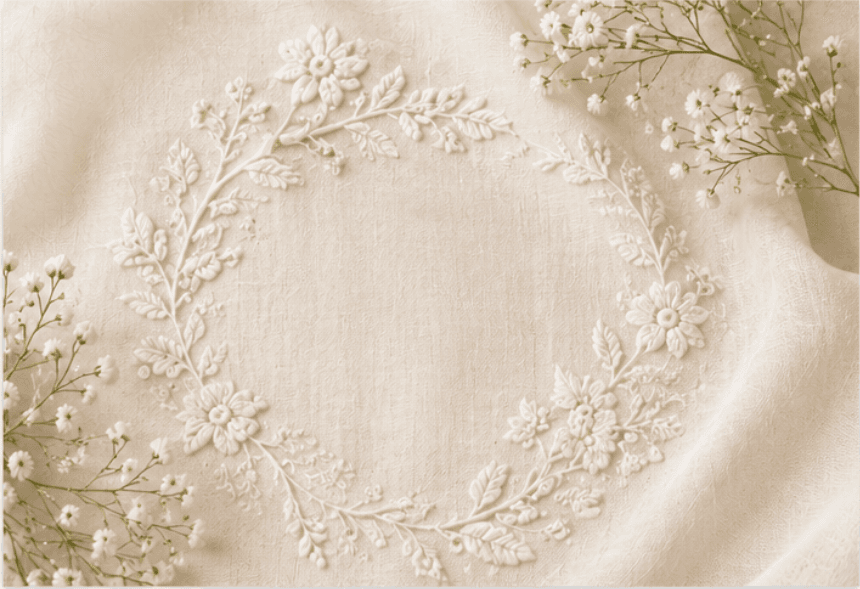
Chikankari is the whitework embroidery of Lucknow: a floral trellis of creepers, buds and paisleys printed in washable ink on fine cotton or sheer fabric, then embroidered — traditionally in untinted white thread — so the pattern reads as texture and shadow rather than colour. Its vocabulary of roughly thirty named stitches falls into three families: flat stitches such as tepchi and bakhiya that lie on or just under the cloth, embossed stitches such as murri and phanda that sit up as tiny grains and knots, and openwork such as jali, where threads of the ground are teased apart with the needle to leave a fine net without cutting the cloth. Worked on pale mulmul, chikan kurtas, saris, dupattas and angarkhas stay cool and near-weightless, and the same piece often passes through several specialists — one for outlining, another for knots, another for jali.
Craft at a Glance
Origin
Lucknow, Uttar Pradesh
Also Known As
Chikan work, Chikan embroidery, Lucknawi chikan, Lucknow chikankari, shadow work
Craft Type
Whitework hand embroidery on fine cotton and sheer fabric
Practising Community
A largely home-based female embroidery workforce across Lucknow and its villages, with men handling block-printing, washing, cutting and trade; historically organised through karkhanas
Materials
Fine cotton mulmul and tanzeb traditionally, now also cotton–silk, georgette, chiffon, organza and mulmul-silk; soft untwisted cotton thread, classically white, with pastel and coloured thread and occasional pearl or sequin accents in modern work; washable blue or grey block-printing ink; and light rice or maida starch for finishing.
Known For
Untinted white thread worked on pale mulmul, chikan kurtas, saris and dupattas built from tepchi outlines, raised murri and phanda knots, and cut-thread jali nets
Where It's Made
Lucknow city and the surrounding Awadh districts — Malihabad, Kakori, Sandila, Sitapur, Barabanki, Unnao, Hardoi, Rae Bareli and Amethi
Time to Create
A few days for a lightly worked kurta; several months for a densely embroidered sari or bridal piece
GI Status
GI-registered as 'Lucknow Chikan Craft' (2008)
Process Steps
Design and block carving
A naqqash draws the floral pattern and it is carved in relief onto seasoned wooden blocks, one block per repeating unit of the layout.
Cutting and block printing
The cloth is cut to garment panels and stamped with the blocks in a fugitive blue or grey ink, giving the embroiderer a printed guide for every motif.
Framing the cloth
The printed panel is stretched in a small wooden adda frame or gathered in the hand so the ground stays taut and the stitches sit evenly.
Outlining with tepchi
Stems, creepers and motif edges are run in tepchi, a long-and-short darning stitch, and in stem stitch, establishing the skeleton of the design.
Shadow work in bakhiya
Petals and leaves are filled with bakhiya herringbone worked on the reverse, so the shape shows on the front as a soft shadow between two travelling lines.
Embossed knots and grains
Flower centres and accents are raised with murri rice-knots, smaller phanda knots, hool eyelets and other embossed stitches that stand up from the cloth.
Jali openwork
Where a net effect is wanted, the needle separates the warp and weft threads and buttonholes the gap, opening a lattice without cutting a single thread.
Washing, starching and finishing
The piece goes to the dhobi to wash out the printing ink, is lightly starched, blued and pressed, and loose threads are trimmed before it is stitched into a garment.
Technique Glossary
Tepchi
A long running or darning stitch used for outlines, stems and light fillings; the fastest and most economical chikan stitch.
Bakhiya
The signature shadow work — a herringbone stitched on the back of sheer cloth so the motif appears on the front as a shaded area edged by two fine lines.
Murri
A small, dense rice-grain-shaped knot worked over a satin base, used in clusters to build flower centres; the most prized and time-consuming embossed stitch.
Phanda
A tighter, rounder millet- or fennel-seed-sized knot, a quicker relative of murri used for stamens and tiny florets.
Jali
Openwork in which the ground threads are teased apart with the needle and secured, producing a delicate net without any thread being cut from the cloth.
Hool
A fine eyelet — a small hole pierced in the cloth and oversewn — often forming the centre of a flower.
Zanjeera
A fine chain stitch, usually run just inside an outline to finish the edge of a leaf or petal.
Hathkati / hathkadi
A scalloped, bracelet-like border stitch that outlines the outer edge of a buti or a hem.
Ghas patti
Slanting satin stitches worked in pairs to resemble blades of grass or small leaves along a stem.
Adda
The small wooden frame on which the printed cloth is stretched taut while it is embroidered.
Buti / booti
A single small floral motif; a field scattered with these is the commonest chikankari layout.
A Craft Through Time
Antiquity
White embroidery on muslin
Foreign travellers to India describe figured and white-worked muslin centuries before the Lucknow craft is named, suggesting deep roots for whitework on fine cotton.
Early 17th century
Nur Jahan and the Mughal court
Lucknow tradition attributes the craft's courtly refinement to the empress Nur Jahan, who is said to have favoured and promoted white needlework on muslin.
18th century
Flowering under the Nawabs of Awadh
After 1722 the Awadh court makes Lucknow a centre of muslin dress, and large karkhanas of printers and embroiderers produce caps, angarkhas and courtly wear.
1856–1857
Annexation and upheaval
The annexation of Awadh and the revolt of 1857 dismantle court patronage; chikankari survives as a cottage trade run through the city's cloth dealers.
20th century
From courtly muslin to the kurta
Production shifts to ready-to-wear chikan kurtas for a national market; piece-rates thin, machine imitation spreads, and NGOs and cooperatives begin organising artisans.
2008
Geographical Indication
'Lucknow Chikan Craft' is registered as a Geographical Indication, formally tying the name to the Lucknow region and its hand technique.
Present
A dispersed livelihood
Tens of thousands of mostly women embroiderers across Lucknow and neighbouring districts work the craft from home, supplying a large domestic and export fashion trade.
Did You Know?
Chikankari's 'shadow work', bakhiya, is stitched almost entirely on the wrong side of the cloth — the embroiderer works a herringbone on the back so that the motif appears on the front only as a pale shadow bounded by two fine lines.
Every craft has a story. Every story begins with tradition.