


Discover

Discover India. East to West. North to South. City by City.

Every place has a story. Stories that sustained us then, sustain us now, and will carry us forward.

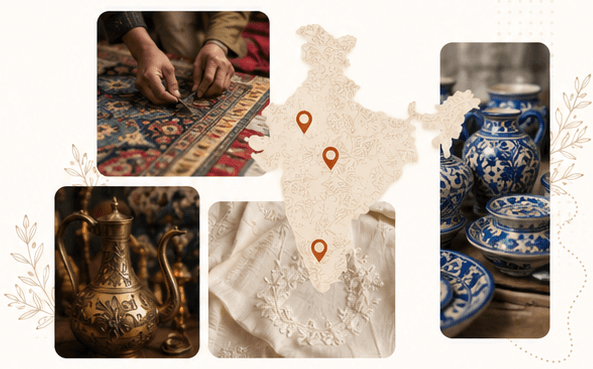
Discover the products, places and traditions that give India’s cities and regions their distinct identity.

Know the place. Discover what it makes.

  • From every corner of India
  • From the people who keep it alive
  • From traditions that evolve
  • From stories worth sharing

Ajrakh Block Printing

Bhuj, Gujarat

Ajrakh is a complex resist- and mordant-printed cloth made in Kutch, Gujarat, chiefly at the villages of Ajrakhpur and Dhamadka. Its deep blue, madder red, black and white patterns are built from geometric grids, eight-pointed stars, trefoils, cintamani dots and floral lattices drawn from Islamic ornament. Traditionally it was the everyday cloth of the Maldhari herding communities, worn as turbans, lungis and shoulder wraps and given at births, weddings and deaths. What sets it apart from most block prints is that it is printed on both faces of the cloth in exact register, so the design reads identically front and back and there is no wrong side. A full Ajrakh passes through sixteen to twenty separate printing, dyeing, washing and drying stages, all using plant and mineral colour.

Kutch Embroidery

Kutch, Gujarat

Kutch embroidery is not one style but a family of them, each belonging to a particular community of the Kachchh district of Gujarat and each with its own stitches, motifs, colours and rules. Suf is a fine counted surface-satin work built on triangles; Kharek is a geometric grid filled with satin stitch; Rabari work is bold chain stitch with big mirrors and free motifs; Mutwa embroidery is minute and jewel-like; Ahir work uses flowing chain-stitch peacocks and flowers. Mirrors of many shapes are anchored throughout. The work covers cholis, skirts, wedding shawls, torans, bags, quilts and animal trappings.

Rogan Art

Kutch, Gujarat

Rogan is a painted-textile craft of Kutch in which a thick, elastic paint is made by boiling castor oil for hours until it gels, then mixing it with mineral pigment. The artist scoops a blob onto a metal stylus (or their palm), draws out a fine thread of the paste, and trails it onto the cloth without the stylus touching the surface, building up the tree of life, flowering trees, peacocks, and dense borders of dots and curls. Many pieces are painted on one half of the cloth and then folded so the wet paste prints a mirror image on the other half.

249+Craft TraditionsAcross India
30States & UTsRich in craft heritage
Country WideSkilled ArtisansKeeping traditions alive
Centuriesof HeritagePassed down generations

Every craft has a story. Every story begins with tradition.